Campaign case study / Anonymized production records
2,853 addresses contacted. 261 replied.
One campaign. 7,738 recorded email sends. A 9.15% reply rate across distinct contacted addresses, excluding replies flagged as bounces or automatic responses.
Observed 16 June–15 October 2026
See the campaign dataDistinct addresses contacted
2,853Complete recipient-hash coverageOne campaign; not a count of companies or paying customers.Distinct addresses with replies
261Bounces and auto-responses excludedBased on the classification flags stored in the application.Address-level reply rate
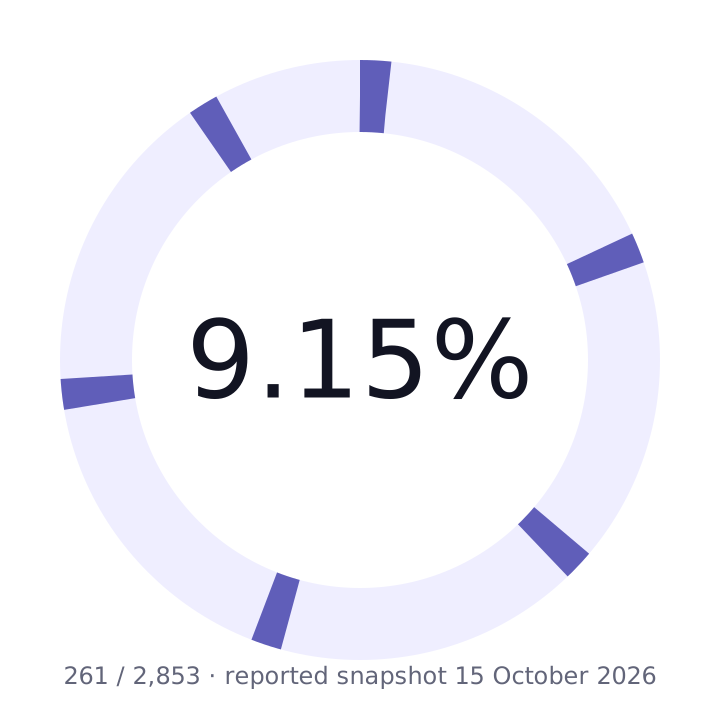
9.15%261 / 2,853 addressesObserved through the snapshot; does not measure positive sentiment.
01 / The operating question
What does a reply rate
actually represent?
An outreach campaign can produce thousands of email sends without reaching thousands of new people. Follow-ups add activity to existing threads; several replies can arrive from one address. A useful case study needs to keep those counts separate.
This campaign offers a particularly clear record. All 2,853 initial sends have usable recipient hashes, and the report counts 2,853 distinct contacted addresses. The reply count is also deduplicated at address level.
261 distinct addresses had a reply not flagged as a bounce or automatic response. That is the outcome measured here.
It is a substantial set of recorded responses to examine. Understanding which became useful business conversations would require reviewing reply content and linking it to downstream records.
02 / What the platform executed
7,738 sends.
Two kinds of work.
The campaign recorded 2,853 initial emails and 4,885 follow-ups. Follow-ups accounted for 63.13% of its send volume. Keeping both figures visible shows the amount of campaign execution behind the contacted-address count.
Initial emails
The first outreach messages recorded as sent. For this campaign, their count matches the distinct contacted-address count.
Follow-up emails
Additional sends in the campaign’s threads. These are messages, not additional distinct contacts.
Addresses with replies
Deduplicated across replies excluding flagged bounces and automatic responses, observed through the snapshot.
These are execution and response counts, not a causal funnel. The report does not establish which replies were caused by follow-ups, and current sequence settings do not prove the historical schedule.
03 / Explore the results
One campaign.
Two views of the data.
Switch between response coverage and the composition of campaign sends. The views answer different questions: how many distinct addresses replied, and how much of the platform’s recorded send activity was follow-up work.
Replies across distinct contacted addresses
Denominator: 2,853 addresses261 ÷ 2,853 × 100 = 9.15%. This is an address-level measure, not a positive-reply, meeting-booking, or sales-conversion rate.
What made up the 7,738 sends?
Denominator: initial + follow-up sends2,853 initial emails36.87% of sends
4,885 follow-ups63.13% of sends
2,853 + 4,885 = 7,738 campaign sends. A recorded send indicates application success; it does not establish inbox placement. Manual conversation messages are outside this total.
04 / What the numbers tell us
The useful finding is
in the detail.
A measurable response base
The report records 261 replied initial threads and 261 distinct addresses with replies. Those counts happen to match in this campaign. That makes the 9.15% figure straightforward to explain without counting repeat reply events as new respondents.
Follow-up work was a large share of execution
At 63.13% of sends, follow-ups were a substantial part of the campaign’s activity. The recorded workload is clear. How much staff time it replaced is not measured, and this study does not assign a reply uplift to it.
Response quality is the next layer
A reply can express interest, decline the offer, or ask a question. The stored classification flags exclude bounces and automatic responses; they do not establish sentiment. To connect this campaign to pipeline, the next analysis would match reply content and recipient records to CRM or calendar outcomes.
05 / Measurement notes
Every headline number
has a definition.
Snapshot: 15 October 2026, 18:10:47 Asia/Yerevan. Observed initial-send dates: 16 June–15 October 2026. Campaign activity is ongoing through the snapshot; table date boundaries use UTC.
| Metric | Recorded value | Definition |
|---|---|---|
| Initial outreach emails | 2,853 | Root outreach messages recorded as sent. |
| Distinct contacted addresses | 2,853 | Deduplicated using nonempty recipient hashes. |
| Follow-up emails | 4,885 | Separate follow-up records recorded as sent. |
| Total campaign sends | 7,738 | Initial emails plus follow-ups; not unique recipients. |
| Addresses with replies | 261 | Excludes replies flagged as bounces or automatic responses. |
| Replied initial threads | 261 | Each initial thread counted once, regardless of reply-event count. |
| Bounce-flagged initial threads | 99 (3.47%) | Thread-level flags; can overlap with later replies. Not a per-email failure rate. |
| Sent initial messages missing recipient hashes | 0 | Complete recipient-hash coverage for this campaign. |
Source, scope, and limits of this case study
Source: Production statistics report · 15 October 2026. User-supplied report describing a consistent, read-only production database snapshot and dashboard-code review. Referenced CSVs and SQL extracts were not supplied for this page. This page derives percentages from the supplied counts; it does not represent an independent database audit.
Campaign scope: the report labels this record “Campaign 04”. All sending in the overall report belongs to one organization. This page describes one workflow, not a separate customer, and does not establish its industry or external-customer status.
Classification: reply exclusions rely on the stored bounce and automatic-response flags, which have not been manually audited for every reply. Internal or test traffic has not been identified and excluded. The figures describe retained records, which may be incomplete lifetime totals.
Delivery: 99 initial threads carry bounce flags (3.47%). These flags may overlap with later replies. They are not a per-email failure rate, and sent status does not prove inbox placement.
Attribution: no pre-platform baseline, meeting outcomes, revenue, or measured labor savings were established. Follow-up volume demonstrates executed work, not incremental response uplift. Historical timing coverage also limits follow-up attribution.
Anonymity: the organization and individual identities are omitted. No customer quote or prior-workflow story has been added without evidence.
Bring structure to your outreach
Keep the sequence moving.
Keep the conversation in view.
Explore SendRush’s workflow for Gmail outreach, scheduled follow-ups, and reply handling.
Explore SendRush